Showing posts with label Moldova. Show all posts

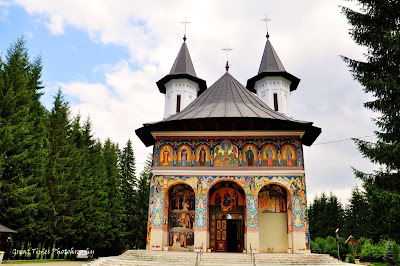
Sihastria Monastery


Sihastria Monastery is located in the north part of Neamt County, at 22 km of Targu Neamt, on the road that goes toPipirig and Vatra Dornei. The secondary road that goes to the monastery it’s about 15 km, runs nearby Ozana river and crosses the valley of the brook called Secu. After 4 km you reach Secu Monastery and after another 3 km you’ll see Sihastria Monastery.

In the year 1942 Sihastria Monastery has a new abbot: father Cleopa. With the help received from Neamt Monastery father Cleopa manages to build all the cells by 1944 .
He also manages to reinforce Sihastria Monastery with his strong belief and in 1946 they build a new chapel. He is send to be abbot at Slatina Monastery , together with another 23 monks but he returns to Sihastria Monastery in the year 1964.  Father Cleopa becomes an icon and a saint among the living. Sihastria Monastery is well known to all pilgrims because of the life of this great priest and monk.

Sihastria Monastery, Moldova, Neamt County, Parintele Cleopa, Father Cleopa, Romania, Orthodox,

Sihastria Monastery, Moldova, Neamt County, Parintele Cleopa, Father Cleopa, Romania, Orthodox,

Sihastria Monastery, Moldova, Neamt County, Parintele Cleopa, Father Cleopa, Romania, Orthodox,

Sihastria Monastery, Moldova, Neamt County, Parintele Cleopa, Father Cleopa, Romania, Orthodox,

Sihastria Monastery, Moldova, Neamt County, Parintele Cleopa, Father Cleopa, Romania, Orthodox,

Sihastria Monastery, Moldova, Neamt County, Parintele Cleopa, Father Cleopa, Romania, Orthodox,

Sihastria Monastery, Moldova, Neamt County, Parintele Cleopa, Father Cleopa, Romania, Orthodox,

Sihastria Monastery, Moldova, Neamt County, Parintele Cleopa, Father Cleopa, Romania, Orthodox,

Secu Monastery


Secu Monastery is a 500 years old Romanian Orthodox settlement. The first hermitage was raised in the year 1530. The buildings that we can see today at Secu Monastery were built in the year 1602 by Nestor Ureche.

The church of Secu monastery was built in 1602 in the shape of a rectangular city, in the middle of the surrounding walls. In the year 1821 here took place the last battle between Turks and Eteristi. The Turkish won the battle and burned the church. After that, most of the buildings and cells had to be rebuild, together with the chapel St Nicholas.

The most important icon from Secu Monastery is the Icon of St Mary, Mother of Jesus from the main church of the monastery. This icon was a gift from ruler Vasile Lupu in 1647 as a sign of respect to Mitropolitul Varlaam (Mitropolit is a high religious position).The icon was brought from Cyprus Island and is known as the Cypriot Icon.

Secu Monastery is representative for the Moldavian architectural style from the end of the XVI century and the beginning of the XVII century.

Secu Monastery, manastirea secu, Neamt County, Romania, Moldova, Orthodox,

Secu Monastery, manastirea secu, Neamt County, Romania, Moldova, Orthodox,

Secu Monastery, manastirea secu, Neamt County, Romania, Moldova, Orthodox,

Secu Monastery, manastirea secu, Neamt County, Romania, Moldova, Orthodox,

Ortoaia, Suceava

Ortoaia is a village in Suceava County, Romania. It is part of the commune of Dorna-Arini.

Ortoaia, Suceava, Dorna, Dorna Arini, Bucovina, Moldova, Romania,

Ortoaia, Suceava, Dorna, Dorna Arini, Bucovina, Moldova, Romania,

Ortoaia, Suceava, Dorna, Dorna Arini, Bucovina, Moldova, Romania,

Ortoaia, Suceava, Dorna, Dorna Arini, Bucovina, Moldova, Romania,

Ortoaia, Suceava, Dorna, Dorna Arini, Bucovina, Moldova, Romania,

Ortoaia, Suceava, Dorna, Dorna Arini, Bucovina, Moldova, Romania,

Ortoaia, Suceava, Dorna, Dorna Arini, Bucovina, Moldova, Romania,

Neamt Monastery

Neamt Monastery is located in Vanatori village, at 15 km north-west from Targu Neamt in a place near the brook Nemtisor, surrounded by green hills.

Neamt Monastery was first mentioned in the XIV century and it’s the oldest religious settlement in this area – it’s also known as “The Jerusalem of the Romanian Orthodoxy”.

Petru Musat was the one that built a stone church at Neamt Monastery to replace the old wooden one. In the year 1471 an earthquake damaged the church and for this reason Stefan cel Mare will build a new church near the old one. The first service was held after the great victory from Codrii Cosminului forest. In the year 1485 Neamt monastery receives a gift from ruler Stefan cel Mare under the form of a bell.

From all the old buildings that once were there, today we can only see the church of Stefan cel Mare and the lower part of the bell-tower built by Alexandru cel Bun. The buildings that can be seen today are from the XVIII – XIX century. Between 1958 and 1961 the church of St Gheorghe (this is the saint that battled the dragon) was rebuilt.

Neamt monastery also holds the oldest library with 18,000 books. Here we can find the tombs of Prince Stefan (the son of Alexandru cel Bun and the uncle of Stefan cel Mare) and the famous abbot Paisie Velicicovschi.

Neamt Monastery, Moldova, Neamt County, Orthodox, Manastirea Neamt,

Neamt Monastery, Moldova, Neamt County, Orthodox, Manastirea Neamt,

Neamt Monastery, Moldova, Neamt County, Orthodox, Manastirea Neamt,

Neamt Monastery, Moldova, Neamt County, Orthodox, Manastirea Neamt,

Neamt Monastery, Moldova, Neamt County, Orthodox,

Neamt Monastery, Moldova, Neamt County, Orthodox, Manastirea Neamt,

Neamt Monastery, Moldova, Neamt County, Orthodox, Manastirea Neamt,

Neamt Monastery, Moldova, Neamt County, Orthodox, Manastirea Neamt,

Neamt Monastery, Moldova, Neamt County, Orthodox, Manastirea Neamt,


Bisericani Monastery

The monastery is located on Mount Pietrosu, at 650 m altitude, 12 km from Piatra Neamt. Access is by car on DN15, Piatra Neamt – Bicaz. Starting from Piatra Neamt, after about 7 km, on the right, way, up, (5 km) is paved, has many switchbacks and leave the traveler`s eyes to admire the exquisite beauty of Bistrita Valley.

Bisericani Monastery, founded by Bogdan Voda III, Prince of Moldavia (1504 – 1517) was built between 1508 -1512 on the foundation of a wooden church, dedicated to the Annunciation, built by the hermit Joseph and his disciples came from the Jordan desert. The wooden Church of Joseph (hermitage Bisericani) was burned and plundered in 1498 by the Tatars. After burning the church, Joseph and his disciples have decided to go to Mount Athos, but the departure to Athos was stop by a miraculous event by the appearing of Holy Mother of God, in an oak. In the reign of Stefanita Voda (1517-1527), grandson of Stephen the Great,  the monks at Bisericani succeedes, with its help, to raise a more enduring sanctuary of stone. . The monastery church has the footprint of changes made ​​by Petru Rares (1527 – 1538 and 1541 -1546) in the year 1535. The flowering that hermitage had reached in the eighteenth century, did it to become a convent. After Cuza’s land reform in 1864, the monastery enters a decline decreasing the number of its inhabitants. In 1885, King Charles I (1866- 1914) transforms it into a prison.

Bisericani Monastery, Church, Moldova, Neamt County, Orthodox, Bisericani,

Bisericani Monastery, Church, Moldova, Neamt County, Orthodox, Bisericani,

Bisericani Monastery, Church, Moldova, Neamt County, Orthodox, Bisericani,

Bisericani Monastery, Church, Moldova, Neamt County, Orthodox, Bisericani,

Bisericani Monastery, Church, Moldova, Neamt County, Orthodox, Bisericani,

Bisericani Monastery, Church, Moldova, Neamt County, Orthodox, Bisericani,

Bisericani Monastery, Church, Moldova, Neamt County, Orthodox, Bisericani,

Bisericani Monastery, Church, Moldova, Neamt County, Orthodox, Bisericani,

Bisericani Monastery, Church, Moldova, Neamt County, Orthodox, Bisericani,

Featured Post

Sihastria Monastery

Sihastria Monastery is located in the north part of Neamt County, at 22 km of Targu Neamt, on the road that goes toPipirig and Vatra Dorn...